
Protein for weight loss
Protein for weight loss: how much you need a day
Protein does not cause weight loss on its own; a calorie deficit does. But enough protein in a deficit helps you keep muscle and can make a plan easier to follow. Healthy adults need at least 0.8 g per kg of body weight a day, and one review suggested 1.2 to 1.6 g per kg for weight management.
Get it on Google Play → Join the iPhone waitlist Available on Android and on the web. iPhone coming soon. Free to start.
- Weight loss needs a calorie deficit. Protein supports it; it does not replace it.
- 0.8 g per kg is the minimum for healthy adults. A practical range suggested for weight management is 1.2 to 1.6 g per kg.
- Whole foods such as eggs, tofu, fish, chicken and lentils can supply it. Shakes are optional.
Is protein good for weight loss?
Protein can help, but it does not cause weight loss by itself. A calorie deficit does that. In a deficit, enough protein helps you keep muscle, and higher-protein diets can improve fullness. A major review found the benefits showed up mainly in people who stuck to the plan, so adherence matters more than the exact number.
How much protein do I need a day to lose weight?
The minimum for healthy adults is 0.8 g per kg of body weight a day. One review on weight management suggested 1.2 to 1.6 g per kg as a practical range, which is about 84 to 112 g for a 70 kg adult. Ask a professional first if you have kidney disease or take medicine.
Work out your own number: protein calculator.
Daily protein by body weight
| Body weight | 0.8 g per kg (minimum) | 1.2 g per kg | 1.6 g per kg |
|---|---|---|---|
| 50 kg | 40 g | 60 g | 80 g |
| 60 kg | 48 g | 72 g | 96 g |
| 70 kg | 56 g | 84 g | 112 g |
| 80 kg | 64 g | 96 g | 128 g |
| 90 kg | 72 g | 108 g | 144 g |
What the research says
- Weight management review (Leidy et al., 2015): higher-protein diets helped in short, tightly controlled studies, with mixed results over longer periods. The benefits were seen mainly in people who followed the plan. The authors suggested 1.2 to 1.6 g per kg a day, with about 25 to 30 g per meal, as a practical target.
- Sports nutrition position stand (Aragon et al., 2017): a wide range of diet styles can work similarly for body composition. For lean, resistance-trained people in a calorie deficit, it suggests 2.3 to 3.1 g per kg of fat-free mass. That is a specialist range for athletes, not a target for most people.
- Muscle-building meta-analysis (Morton et al., 2018): extra protein from supplements did not add more muscle from resistance training beyond about 1.6 g per kg a day in total. That finding is about building muscle, not about weight loss.
What 100 g of protein can look like in a day
| Food (USDA entry) | Amount | Protein | Calories |
|---|---|---|---|
| Egg, hard-boiled FDC 173424 | 100 g | 12.6 g | 155 |
| Greek yogurt, plain, lowfat FDC 170903 | 170 g | 16.9 g | 124 |
| Chicken breast, roasted, no skin FDC 171477 | 150 g | 46.5 g | 248 |
| Tofu, firm FDC 172475 | 100 g | 17.3 g | 144 |
| Lentils, boiled FDC 172421 | 100 g | 9.0 g | 116 |
| Total from these five foods | 102 g | 787 |
The 1,600 kcal day with a 100 g protein target is the example in the macro calculator. More foods are ranked in high-protein foods, including breakfast options.
Are protein shakes good for weight loss?
They can be a convenient way to reach a protein target, but they are not required and they add calories. Whole foods such as eggs, tofu, fish and lentils supply protein too. If you use a shake, check the label for protein, calories and added sugar, and count it in your daily total.
Can you eat too much protein?
For healthy people, intakes within the ranges above are generally considered safe. Very high intakes add calories and can be a problem for people with kidney disease. Protein also supplies 4 calories per gram, so it counts toward your daily target. Ask a professional if you have a health condition.
Turn a target into meals with the macro calculator.
Who should check with a professional first?
Speak to a doctor or registered dietitian before raising protein or cutting calories if you have kidney disease, are pregnant or breastfeeding, are under 18, take medicine, have diabetes or another condition, or have or may have an eating disorder. This page is general information, not medical advice.
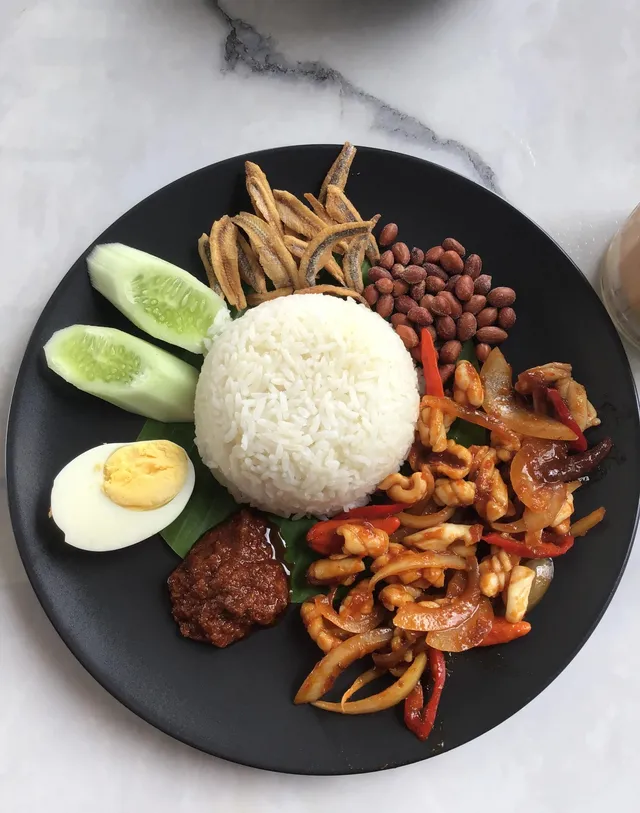
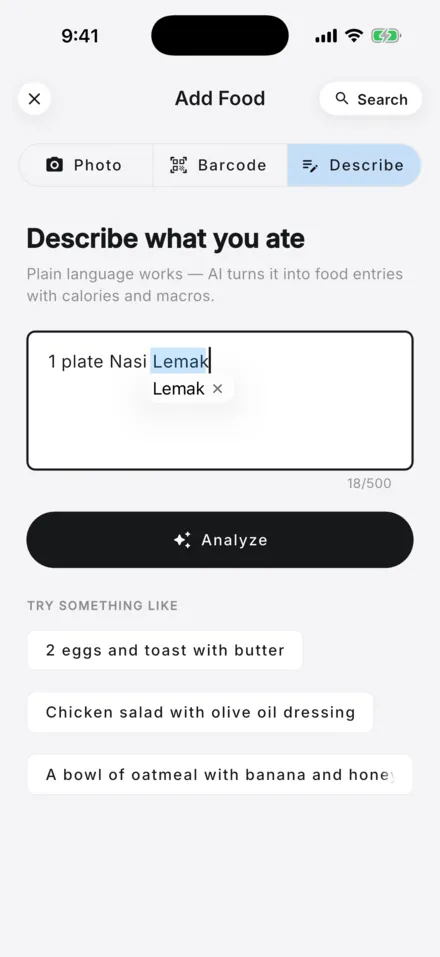
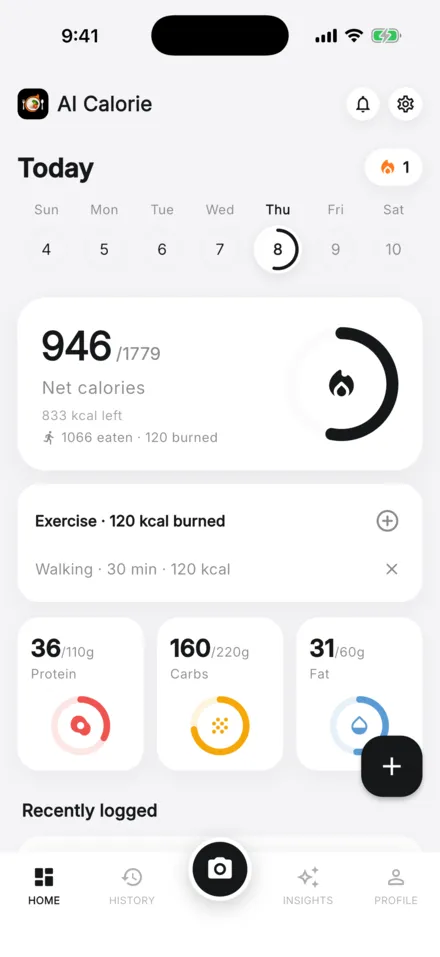
The app screenshots show the current English interface.
See AI Calorie in 39 seconds


Sources
- Leidy HJ, Clifton PM, Astrup A, et al. "The role of protein in weight loss and maintenance." Am J Clin Nutr 2015;101(6):1320S-1329S. PubMed 25926512 · doi:10.3945/ajcn.114.084038
- Aragon AA, Schoenfeld BJ, Wildman R, et al. "International society of sports nutrition position stand: diets and body composition." J Int Soc Sports Nutr 2017;14. PubMed 28630601 · doi:10.1186/s12970-017-0174-y
- Morton RW, Murphy KT, McKellar SR, et al. "A systematic review, meta-analysis and meta-regression of the effect of protein supplementation on resistance training-induced gains in muscle mass and strength in healthy adults." Br J Sports Med 2018;52(6):376-384. PubMed 28698222 · doi:10.1136/bjsports-2017-097608
- Institute of Medicine. Dietary Reference Intakes for Energy, Carbohydrate, Fiber, Fat, Fatty Acids, Cholesterol, Protein, and Amino Acids. National Academies Press; 2005. (RDA 0.8 g of protein per kg; Acceptable Macronutrient Distribution Ranges.)
- U.S. Department of Agriculture, FoodData Central, SR Legacy: Egg, hard-boiled (FDC 173424), Greek yogurt, plain, lowfat (FDC 170903), Chicken breast, roasted, no skin (FDC 171477), Tofu, firm (FDC 172475), Lentils, boiled (FDC 172421). Public-domain data.
Related: protein calculator · macro calculator · calorie deficit guide · low calorie meals · GLP-1 recipes · how to lose weight safely · high-protein foods
AI Calorie gives general nutrition information and AI-generated estimates. It is not medical advice. See medical review and our Terms of Use.