
Calorie deficit guide
What is a calorie deficit and how do you calculate it?
A calorie deficit means eating fewer calories than your body uses in a day, so it draws on stored energy. About 500 calories a day is a common starting point and roughly matches 0.5 kg a week, though that figure is only a rule of thumb. Work yours out in three steps below.
Get it on Google Play → Join the iPhone waitlist Available on Android and on the web. iPhone coming soon. Free to start.
- Deficit = calories you use minus calories you eat. Weight loss needs a deficit that you can keep up.
- Aim for 0.5 to 1 kg a week. Do not go below 1,200 calories (women) or 1,500 (men) a day without medical supervision.
- The numbers are estimates. Check your real weight trend every two to three weeks and adjust.
What is a calorie deficit?
A calorie deficit is the gap between the calories your body uses in a day and the calories you eat. When you eat less than you use, your body makes up the difference from stored energy, including body fat. You can create a deficit by eating less, moving more, or both.
How do I calculate my calorie deficit?
Estimate your basal metabolic rate with the Mifflin-St Jeor formula, multiply by an activity factor to get your daily energy use, then subtract your chosen deficit. The result is your daily calorie target. It is an estimate, so adjust it using your real weight trend over a few weeks.
- Basal metabolic rate (BMR): the calories you burn at rest, from your age, sex, height and weight.
- Daily energy use (TDEE): BMR multiplied by an activity factor, from 1.2 for little exercise to 1.9 for a very active routine.
- Daily target: TDEE minus your deficit, such as 500 calories.
| Worked example | Value |
|---|---|
| Person | Woman, 30 years, 165 cm, 65 kg, lightly active |
| BMR (10 x 65 + 6.25 x 165 - 5 x 30 - 161) | about 1,370 kcal |
| TDEE (BMR x 1.375) | about 1,884 kcal |
| Daily target with a 500 kcal deficit | about 1,384 kcal |
Do it for you: calorie deficit calculator · TDEE calculator · BMR calculator.
How big should my calorie deficit be?
| Daily calorie deficit | Approximate loss per week | Comment |
|---|---|---|
| 250 kcal | 0.23 kg | Gentle, easy to keep up |
| 500 kcal | 0.45 kg | A common starting point |
| 750 kcal | 0.68 kg | Faster, harder to sustain |
| 1,000 kcal | 0.91 kg | Very large; not suitable for most people |
Smaller deficits are easier to live with and lose less muscle. Because your body adapts as you lose weight, loss usually slows over time, so compare the estimate with your real trend every two to three weeks.
What is the lowest number of calories I should eat?
As a general guide, do not go below 1,200 calories a day for women or 1,500 for men without medical supervision. These are cautious floors, not targets, and many people need more. If your calculated target falls below the floor, choose a smaller deficit instead.
Is the 7,700 calories per kg rule accurate?
It is a rough guide. The idea that about 7,700 calories equal 1 kg of body fat overstates weight loss over time, because your energy needs fall as you lose weight. Researchers showed this in a 2011 Lancet paper. Treat the estimate as a starting point and compare it with your real weight trend.
Does exercise count towards a calorie deficit?
Yes. Activity raises the calories you use, so you can create a deficit by eating less, moving more, or both. As an example, 30 minutes of brisk walking uses about 170 kcal for a 70 kg person, using the 2024 Compendium of Physical Activities. See the exercise guide for more activities.
Best exercises for weight loss · calories in 10,000 steps
Fitting local meals into a deficit
A daily target only helps if you know what your meals contain. With the example target of about 1,384 kcal, a 475 kcal plate of chicken rice is roughly a third of the day. See calories and sodium for Singapore dishes on healthy hawker food in Singapore and the hawker food calorie tables.
Who should talk to a professional first?
Speak to a doctor or registered dietitian before dieting if you are pregnant or breastfeeding, under 18, have diabetes or another condition, take medicine, or have or may have an eating disorder. Calorie tracking is not for everyone, and stopping is always allowed.


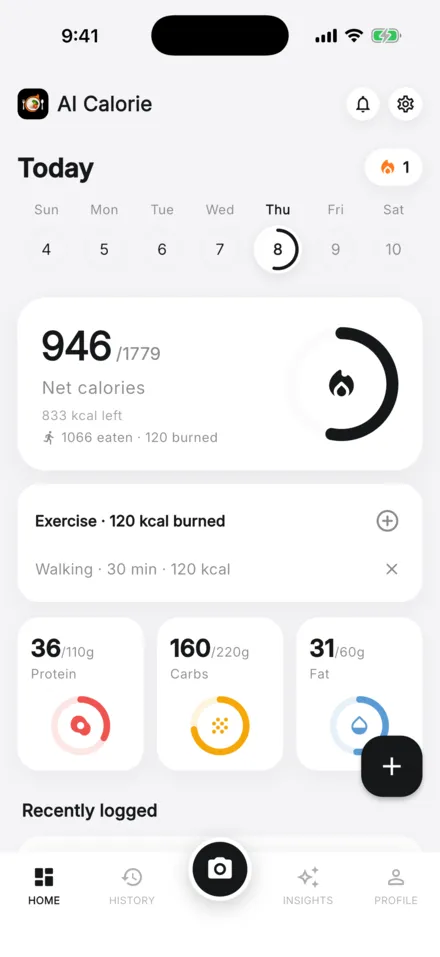
The app screenshots show the current English interface.
See AI Calorie in 39 seconds


Sources
- NHS, "Tips to help you lose weight" (150 minutes of activity a week, 0.5 to 1 kg a week, do not lose weight suddenly, do not skip meals). nhs.uk, checked 7 November 2026.
- Hall KD, Sacks G, Chandramohan D, et al. "Quantification of the effect of energy imbalance on bodyweight." Lancet 2011;378(9793):826-837. (Why the 7,700 kcal per kg rule is only a rough guide.)
- Mifflin MD, St Jeor ST, et al. "A new predictive equation for resting energy expenditure in healthy individuals." Am J Clin Nutr 1990;51(2):241-247. doi:10.1093/ajcn/51.2.241
- Herrmann SD, Willis EA, Ainsworth BE, et al. "2024 Adult Compendium of Physical Activities." J Sport Health Sci 2024;13(1):6-12. pacompendium.com, MET values checked 7 November 2026.
Related: how to lose weight safely · calorie calculator · food diary guide · protein for weight loss · low calorie meals · AI Calorie for Singapore
AI Calorie gives general nutrition information and AI-generated estimates. It is not medical advice. See medical review and our Terms of Use.