
BMR calculator
BMR calculator: how many calories do you burn at rest?
Your basal metabolic rate (BMR) is the number of calories your body burns at complete rest to keep you alive. This BMR calculator uses the Mifflin-St Jeor formula, and also shows the revised Harris-Benedict and Katch-McArdle results. Multiply your BMR by an activity factor to estimate your daily calories.
Get it on Google Play → Join the iPhone waitlist Available on Android. iPhone coming soon. Free to start.
Use the BMR calculator
What is BMR?
BMR, or basal metabolic rate, is the energy your body needs at rest for breathing, circulation, temperature control and cell repair. It is usually the largest part of your daily calories, often about 60 to 70 percent. Eating well below your BMR for long is not advised without medical supervision.
How do I calculate my BMR?
Use the Mifflin-St Jeor formula: 10 times weight in kg, plus 6.25 times height in cm, minus 5 times age, then add 5 for men or subtract 161 for women. Other formulas give slightly different numbers. Treat the result as an estimate and compare it with your real weight trend.
Men: BMR = 10 × weight (kg) + 6.25 × height (cm) − 5 × age + 5
Women: BMR = 10 × weight (kg) + 6.25 × height (cm) − 5 × age − 161
What is the difference between BMR and RMR?
BMR is measured under strict conditions, such as after fasting and full rest, while resting metabolic rate (RMR) is measured under looser conditions and is usually slightly higher. Online calculators, including this one, estimate either with the same kind of formula, so for planning meals the difference rarely matters.
How do I turn BMR into daily calories?
Multiply your BMR by an activity factor from 1.2 for a desk job with little exercise to 1.9 for very hard daily training. The result is your total daily energy expenditure, or TDEE, which is roughly the calories that keep your weight steady. The table above shows each level.
More: TDEE calculator · calorie calculator
Log what you eat in the app
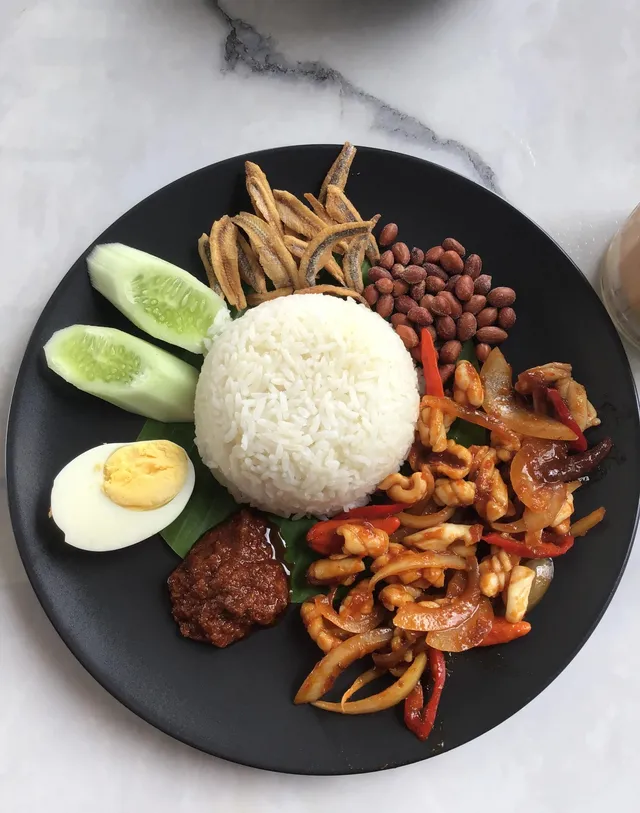
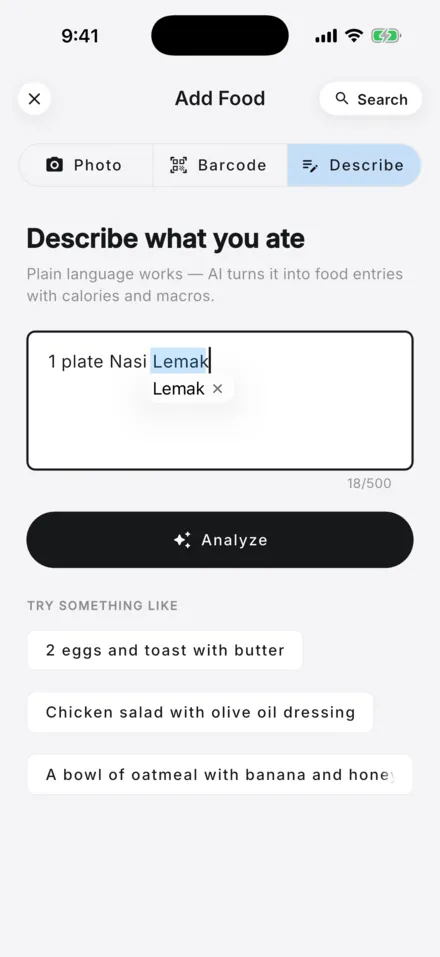
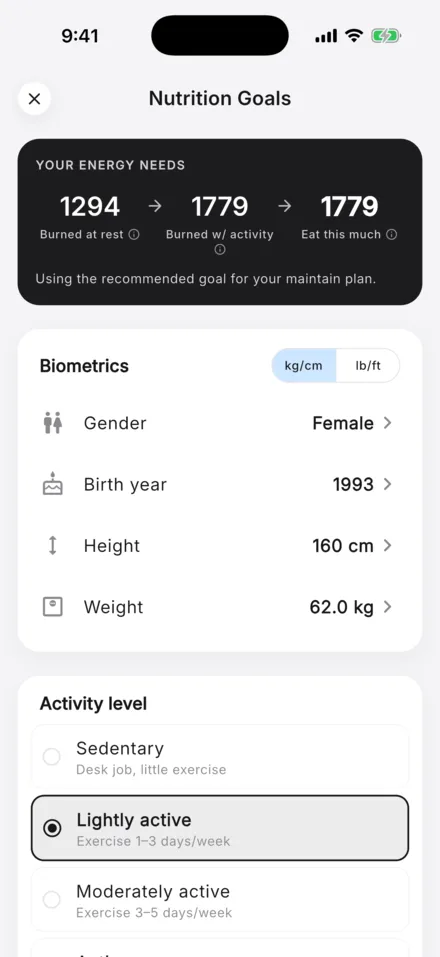
A target only helps if you know what you eat. AI Calorie estimates calories and macros from a photo or a short description. It is free to start with daily limits: see pricing. This calculator is not medical advice; see medical review.
Sources
- Mifflin MD, St Jeor ST, et al. "A new predictive equation for resting energy expenditure in healthy individuals." Am J Clin Nutr 1990;51(2):241-247. doi:10.1093/ajcn/51.2.241
- Roza AM, Shizgal HM. "The Harris Benedict equation reevaluated: resting energy requirements and the body cell mass." Am J Clin Nutr 1984;40(1):168-182.
- McArdle WD, Katch FI, Katch VL. Exercise Physiology: Nutrition, Energy, and Human Performance. Wolters Kluwer. (Katch-McArdle formula: 370 + 21.6 x lean body mass in kg.)

AI Calorie gives general nutrition information and AI-generated estimates. It is not medical advice. See medical review and our Terms of Use.